The Craft Factor - Plundering Art

Volume 18, number 1, Winter 1993/Spring 1994 

Cultural appropriation is a term that has become more common in recent times. A growing awareness of what it means to "borrow" aspects of another culture, and the negative implications of this has led to an increased dialogue about this issue.

Cultural appropriation in art is a longstanding occurrence. Today we look at The Craft Factor from Winter 1993/Spring 1994 and a very interesting article by Allison Muri about appropriation in art.


Muri discusses the complexities surrounding appropriated art, from benign intentions to damaging results:


Reasons for cultural appropriation vary, and unfortunately in some cases it just comes down to money:


However, that is not always the case, but then the question becomes where to draw the line:


So, as Muri says, the question remains: what is the artist's responsibility?


Read the full article here


Lampwork Glass: Spotlight on Jolene Dusyk

Submitted by: Maia Stark, Gallery Assistant

“Lampworking” is a glasswork technique widely practiced in the production of beads, figurines, marbles, ornaments, scientific instruments, and more (wikipedia). As a method, lampwork requires using a flame to melt and form glass. While in the past artists used oil fueled lamps to heat the glass (hence the term “Lampwork”), modern day lampworkers typically use a torch connected to propane or natural gas (lampwork.com). Early lampworking was accomplished in the flame of an oil lamp, with the artist using tools and blowing air into the flame through a pipe in order to manipulate the stretch of flame (wikipedia).

Despite no longer using “lamps,” artists working in this technique continue to use the term in order to distinguish their work from glassblowing or other types of hot glass techniques. During the method of lampwork, a torch is safely secured to table or workbench, and it remains stationary while the artist moves the glass around the flame. This is done by slowly introducing the glass (in the shape of a rod or tube) into the flame. This must be done slowly, to prevent cracking from thermal shock. 

Jolene Dusyk demonstrates manipulating glass with the heat of a torch
A detail of a completed necklace with lampwork beads (Jolene Dusyk, SCC).
Once the glass is melted to a sufficient state, the artist forms the glass piece by using hand movements, blowing, and shaping with tools, such as a specially coated steel mandrel, in order to wind the molten glass around it. As a last action, the glass work is often annealed (heated to toughen the material) in a kiln to prevent cracking or shattering (wikipedia). This must be done carefully as well, however, as heating or cooling the glass too quickly causes the different layers of glass to expand or contract at different rates, causing cracking or breaking (howstuffworks).

Jolene Dusyk, a professional craftsperson with the Saskatchewan Craft Council, works with lampworking, specifically creating original and one-of-a-kind glass beads for her line of jewelry, JoJo Beads. Working in a variety of lush colours, Jolene “flame-softens glass rods, transforming the molten glass into one-of-a-kind beads. The beads are then designed into inspired pieces of jewelry” (JoJobeads). Dusyk’s vibrant pendants and bracelets are available for perusal in the SCC Boutique, and, for an extra sneak peak of Dusyk’s capacity for creativity and design, visit the gallery before April 12th to see her piece in our current exhibit, Wearable Art.

“Mable’s Equity” by Jolene Dusyk (SCC) 
Dusyk’s piece, “Mable’s Equity,” which won Best in Show at the Wearable Art Gala in October of 2013, incorporates Lampwork beads into a dress composed of chicken wire, twine, and other “pedestrian” materials. 
Wearable Art runs February 28th to April 12th, with a closing reception on Saturday April 12, 2-4PM. Also be sure to check out the Artists’ Talks on Saturday March 22nd at 2PM in the gallery!

The SCC gallery and boutique is located in the Saskatchewan Craft Council’s Affinity Gallery at 813 Broadway Avenue, Saskatoon, SK.

Saskatchewan in Scottsdale

Saskatchewan comes to Scottsdale, Arizona this week, in the form of an art show and gallery. From March 10th-27th, the group exhibition Saskatchewan will be on display. 

The Saskatchewan Craft Council has had the opportunity to join in on this venture, headed up by SaskArt, alongside numerous Saskatchewan galleries; Art Placement, Assiniboia Gallery, Collector's Choice Gallery, Hand Wave Gallery, Mysteria Gallery, Rouge Gallery and Stall Gallery.

Stonehouse Bench by Michael Hosaluk, one of the artists represented in Scottsdale.
Photo by Vivian Orr
As stated in a press release by Art Placement, "The goal of the project is to increase the exposure of Saskatchewan's artists and craftspeople beyond the borders of our province. Scottsdale has a significant number of Canadian vacationers and retirees as well as a vibrant commercial gallery scene and a reputation for strongly supporting the arts."
Read the full piece here

The SCC is very excited to be part of this project - a great to chance to introduce work of Saskatchewan artists to the fine folks in Scottsdale!

Enamel Jewellery: Spotlight on Deborah Potter

Submitted by: Maia Stark, Gallery Assistant

Enamel application is a method of decoration which has been practiced since ancient times, across various cultures and geographies. Although the exact origins of this process are unknown, excavations on Cyprus in the 1950s found cloisonné enameled jewelry which date from the 13th and 11th century BC; as well, other techniques of enamel applications can reach back as far as the 5th century BC! (AJU)

Enamels have been applied to stone, pottery, jewelry, and other surfaces throughout Greece, Scotland, Ireland, Asia, and the Middle East (Wikipedia).  The process of enameling is, at its simplest, a decoration technique in which glass of a certain composition is fused to an underlying metal. This style of adorning jewelry, in particular, allowed for colour and vibrancy in jewelry without the use of gemstones—stones which were either inaccessible economically or geographically. While enameling jewelry may have begun or been popular as an alternative to gemstones, enamel in jewelry came into its own in Europe and North America during the Neo-renaissance and Art Nouveau periods (AJU). Some of the most beautiful and creative examples of enamel jewelry come from these periods.
Rene Lalique, Art Nouveau Plique-à-Jour Dragonfly Brooch, Lang Antiques.
Cloisonné enamel plaque, Byzantine Empire,
ca. 1100, 
Wikipedia.


Contemporary artists, however, work in a wider range of textures and design. Deborah Potter, a professional craftsperson with the SCC, creates one of kind pendants with enamel processes.
 Enamel pendant by Deborah Potter
The above image of a pendant made by Deborah Potter captures her organic use of texture, colour, and design. There are many various techniques of enameling, such as Cloisonné, Champlevé, Peinture sur émail, Émail en ronde bosse, Guilloché, and so on. These techniques can vary greatly or slightly from each other, though they all have the same basic steps in common.

Enamel, as a material in itself, is a type of allochromatic glass that consists usually of quartz sand, iron oxide, potassium oxide (potash) and borax (AJU). Melting these components together, firing at temperatures between 700 and 900 degrees Celsius, creates what is referred to as a “fondant,” or “flux:” a transparent and colourless (though slightly blue/green) glass. The addition of different metal oxides or chlorides establishes the variety of colour in the fondant, which is eventually applied onto a clean metal, typically gold, silver or copper alloys (AJU). After the fondant has dried, the piece needs to be fired again in a furnace or kiln. Placing the enamel piece back into the kiln or furnace helps the piece gain a vitreous lustre, a favoured characteristic of enamel work, though the artist could polish the piece by hand for a more controlled, flat look.

For an in-person look at Deborah Potter’s enamel jewelry, come by the SCC Fine Craft Boutique, located in the Saskatchewan Craft Council’s Affinity Gallery at 813 Broadway Avenue, Saskatoon, SK.

Manifesto for Making: Report


Submitted by: Vivian Orr, SCC Marketing and Communications Coordinator

Manifesto for Making: Report
23 March 2013
The Manifesto for Making was held as a part of the Heritage Crafts Associations’ annual Spring Conference at the Victoria and Albert Museum, London on 23 March 2013. The report is worthy of interest from us on the other side of the pond.
The first line of the forward to the report:
 If there is a key message I take from this manifesto it is that craft is central to life not a sideline, making is a crucial part of what makes us human.
 ~Robin Wood, Chair of the HCA
Conference delegates were asked three questions. Here is a brief summary of their responses.
1.       Why is making important? The responses indicated that making is important not only to the maker, but to everyone as human beings. There was a lot of emphasis on the importance of making on an emotional and personal level, with particular reference to fulfilment and satisfaction, and to the opportunity to express creativity.
2.       Where should making be? The responses indicated that making needs to be much more visible and prominent and should be physically everywhere. There was a particular emphasis on craft in education at all levels, as a way of giving people access to making.
3.       How do we get there? The dominant responses reflected non-makers. They indicated that publicity and promotions are vital to get making to where it should be – in the public consciousness. Another set of responses were maker specific and focused on the need for practical support for makers: marketing assistance, training, business and financial support.


A Sociological Point of View

Submitted by: Sydney Luther, Gallery Assistant

As a Sociology student and non-artist working at the Saskatchewan Craft Council, I think I have a unique view of the artist and their work. I admire the courage it takes to choose to be an artist for a living and I have developed an understanding of the value of the unique work produced by our membership.

Photo source
Anyone who has taken an “Introduction to Sociology” course knows about Karl Marx’s theory of alienation. If you haven’t, or you need a refresher, here is a summary: Marx theorized that Capitalism creates alienation between the worker and the products he or she is hired to produce. 

In Capitalism, the lowest working class citizens are employed as factory workers and in other production-line type positions. For example, imagine a job in which one’s only responsibility is to place toothpaste caps on toothpaste tubes as they roll down a conveyor belt, day in and day out. These types of positions do not allow the worker to have a voice in what they are producing and have no impact on what later happens to these products. 

Consider the Line Cook: he has no say in what kind of food is prepared, he just knows which ingredients to put together to create the exact same dish every time. The Head Chef designs the dishes, and the Line Cook simply follows instructions. Obviously this Line Cook is not going to stay very excited about food, when he’s creating the exact same dishes every single day for weeks or months on end. Marx labeled this lack of passion for the products the worker is creating as alienation from the product. This leads to alienation from the act of producing – which is basically a lack of passion for one’s job. If a person has no part in designing the product they create, and no influence on what happens after they do their part, of course they are not going to gain any happiness from their job!

As I was sitting in class learning about Marx, my professor asked us how one can avoid such alienation from one’s job and the product one creates. This sparked an obvious answer within me: become an artist! The artist is someone who rejects the basic ideas of capitalism. An artist designs whatever he or she wishes to create, and then follows through with the creation process. An artist never creates the same piece twice and, as I've seen from the members of the Craft Council, can choose to create a vast array of different types of products in different mediums. The artist then has the power to choose what happens to his or her products. He or she sets the price and decides to who they will sell. This type of power in the process of production avoids the capitalistic alienation of which Marx warned.
I write all of this just to say that although the life of an artist may not be a wealthy one, and it may not be the easiest road to choose, I truly believe it can lead to happiness. If you were meant to create, then you should be creating in any way you know how!
For more information about Marx’s theory of alienation, check out the Wikipedia page on the subject here 

The book in which Marx presents his theory of alienation
photo source


Relief and Intaglio Printmaking: Spotlight on Paul Lapointe

Submitted by: Maia Stark, Gallery Assistant

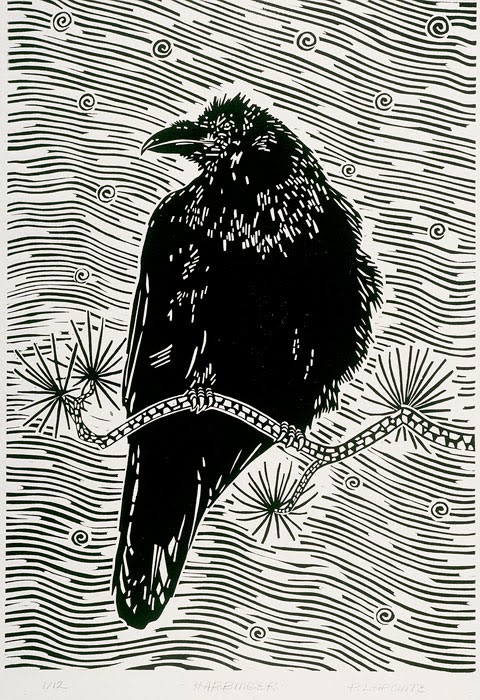
Printmaking is chosen as a form not only for its ability to create multiples, as discussed in my last blog post, but also for the unique qualities that various printmaking techniques offer. Paul Lapointe, a professional craftsperson with the Saskatchewan Craft council, employs many printmaking techniques in his repertoire as a multi-media artist. In particular, Lapointe works with woodblock printing and drypoint etching.


A selection of carving tools, available from Lee Valley Tools

Woodblock printing is known as “relief” printmaking. In this process one would, using carving tools such as the ones pictured above, carve out sections on the woodblock according to a pre-planned design. These areas which are carved will not pick up ink, and so the “relief”—or highest point on the block—is what will be printed. When running a roller of ink over top of the board, the carved out areas will remain white. This process can be thought of as the opposite of drawing with a marker- what you touch will not be printed, what is left behind will pick up ink. Woodblock prints can be monochromatic, or, “one-colour:” this means that the printmaker would have only printed one layer of ink (e.g, a black and white woodcut, where the “white” is the paper). Woodblock prints can also be multi-colour however; so that after printing a first layer, the printmaker would go back to the woodcut, carve more wood away, and print another colour over top of that first layer. This is called “reductive” printmaking, and works from lightest to darkest- the very last un-carved areas left on the block will be printed in the darkest ink as the layers of colour build up.
Relief printing: A represents the block, B is the paper lifting the ink away from the block. (Wiki commons)

Harbinger by Paul Lapointe, Woodcut on paper

Dry point etching, in contrast, is known as an “Intaglio” printmaking technique. This process can be considered the opposite of relief printmaking; the ‘carved’ areas are the parts which will pick up ink, as if one was to naturally draw with a pencil. Drypoint etching is accomplished through scratching or “etching” into a metal plate (traditionally copper) with a sharp pointed instrument. Then, the plate is inked up. Instead of printing the plate as is, however, like you would with the woodblock, the ink is pushed into the etching, usually by dragging a piece of cardstock in all directions on the plate. Then a piece of tarleton cloth is used to clean and pick up the extra ink sitting on top of the plate. The ink should be in the plate, not on the plate, for this technique. Then the plate is run through the printing press with slightly damp paper (which will pick up the ink better than dry paper).  
 a diagram depicting how paper lifts the ink out of the depressions in Intaglio printmaking (Wiki commons)


Mackenzie Bee by Paul Lapointe, drypoint on paper with chine-collé

While woodcut prints have a graphic, sharp edged feel, drypoint etchings tend to have a soft look to them. This is primarily due to the “burr”: a rough ridge of metal thrown up on each side of the line created by the etching tool. The result is a soft and dark image with great potential for detail and intricacy. The different strengths in these techniques are portrayed well by Lapointe’s work, which is often themed around nature and its forces, animals, and landscapes.  Having grown up in Northern Saskatchewan, Lapointe’s earliest influences were that of the natural world (SCC Membership Directory).Two great examples of these techniques are Lapointe’s pieces Dancing Raven and Muskeg Spruce, both pieces on view now at the SCC Boutique!

For great resources on printmaking techniques and ideas, check out the following resources: