Showing posts with label Boutique. Show all posts

Turning and Piercing: The work of Rodney Peterson

Submitted by: Maia Stark, SCC Gallery Assistant

Rodney Peterson, a professional craftsperson with the Saskatchewan Craft Council, was born in Duncan, B.C, in 1943. Having been raised and spent most of his life is Saskatchewan, his work is mostly inspired by the Boreal forest around his Nipawin home (NAC). Peterson has had a variety of careers throughout his life: construction workers, physics teacher (for 29 years!), rail line worker, taxi driver, and professional artisan, just to name a few! (NAC)  Peterson is a self-taught woodturner, developing his skill and technique over the years by attending workshops with master woodturners. 
Many may be familiar with the concept of woodturning, but here’s a quick rundown for those who are new to the term!
Woodturning is a process which uses a “Lathe”: a machine that rotates the piece of wood you are working with on its axis (
Wiki). While the piece is turning (at high speeds!), the craftsperson uses various tools to carve the wood, essentially slicing it down into the shape they want. The appeal of using a lathe is that by nature of the process the finished piece will have a (horizontally) symmetrical design. The origin of woodturning traces back to approximately 1300 BC in Egypt, where a two-person lathe was developed: one person would turn the wood with the help of a rope, while the other used a sharp tool to carve (Wiki). During the industrial revolution, the lathe was motorized in order to speed up production, focusing on mass production of wooden products. 


Peterson at work (Saskatchewan Craft Council)
Despite the “quick-production” origins of contemporary woodturning, many woodworkers incorporate a high standard of aestheticism, making unique pieces enhanced by further carving, coloring, piercing gilding, or by applying pyrography. Rodney Peterson’s work employs many of these techniques, notably coloring and piercing. Woodturning has its various hiccups and problems to overcome, just as many techniques do. One thing to consider is the direction of the grain and the direction one carves. Cutting in the wrong direction can cause the fibres to separate and “tear out,” creating a rough and damaged looking surface (Wiki). As well, there is a patience, foresight and understanding of woodturning required to be able to anticipate the shape and look of what’s being created. Carving too much or too little could lead to a piece of which the form could be disproportionate or seem awkwardly shaped.
Eye of the Garden by Rodney Peterson. This turned piece incorporates coloring and pyrography  (NAC).

Birch Ribbon Vase by Rodney Peterson. Another turned and colored piece, this vase has also had piercing applied to it (NAC).

Peterson’s works often take celebration in the small “faults” found in the wood he uses, often sourcing wood from the boreal area around his own home. Some turned pieces focus on a particular knot, enhancing the natural shape of the tree’s original growth pattern. 
By Rodney Peterson (SaskatchewanCraft Council)

To see some of Rodney’s works in person, come by the Affinity Boutique! The SCC gallery and boutique is located in the Saskatchewan Craft Council’s Affinity Gallery at 813 Broadway Avenue, Saskatoon, SK.

Artist Spotlight: Donna Cutler

Submitted by: Sydney Luther, Gallery Assistant.

Donna Cutler
Donna Cutler is a fine craft artist featured in the SCC Fine Craft Boutique. The artist, who resides just outside of Saskatoon in Beaver Creek, focuses mostly in the medium of free motion embroidery. Although she was originally self-taught, she went on to receive a certificate for Art and Design Level III at the Gail Harker Center for Creative Arts in Washington State, as well as certificates in hand embroidery and machine embroidery. Cutler says, “I arrived at fiber art through a long process of trying many other art forms. I started out drawing as a child, then as an adult, developed an interest in sewing, rug hooking... I also worked with various forms of hand needlework. Later on, I took a quilting class which was pivotal for me, as it led to art quilting.”

Cutler, who grew up in Winnipeg, specializes in what she calls ‘thread paintings,’ in which she depicts nature in near-photographic detail. She remarks, “I'm very lucky now to live south of the city within easy access to places like the Beaver Creek Conservation Area and Cranberry Flats.” Cutler takes many photographs of everyday nature settings to recreate using thread and embroidery techniques. She also utilizes photographs her husband Adrian takes, as well as ones supplied to her by good friend Judy Wood.

Autumn Birches by Donna Cutler
Cutler’s work is unique from other fibre artists’ because of her extreme attention to detail, which creates incredibly realistic looking textures. This style is not one that is easily replicated. She also dyes all her own fabrics and spends most of her summers dying fabrics at her home.
Bend in the Creek by Donna Cutler
On top of her unique fine craft work, Cutler also teaches and does commissions. To read more about this, check out her blog here. Cutler will be a Feature Artist at Anna Hergert’s Open Studio Workshop June 27th and 28th, 2014 and will be selling her work at at Art at Solar Gardens (previously Art at Agar's) in September. Cutler’s beautiful work is also for sale in the SCC Fine Craft Boutique. Please come visit and check it out!

A Look at Precious Metal Clay

Submitted by: Sydney Luther, Gallery Assistant

Many of the craft mediums which are employed by SCC members are ancient art forms that have evolved as technology has changed. Some techniques have not changed for hundreds of years. However, one of the newest craft art mediums is silver clay and precious metal clay. Silver clay was developed in Japan in 1990, which makes it just 24 years old! Considering ceramic pottery dates back to almost 30,000 years ago, this is an extremely new medium.


These earrings are an example of precious metal clay, created by Tara Duckworth.
Precious metal clay jewellery looks like other silver jewellery and is just as durable, but its process is very different than traditional metalsmithing. Metal clay consists of very small particles of precious metal such as gold, silver, and bronze within a moldable binder, which can be shaped similarly to polymer or modelling clay. However, once fired in a kiln, the binder burns away and the pure metal is left behind to create a dense metal object. Firing causes the object to shrink anywhere between 8 and 35% depending on the specific product used.

Earrings by Tara Duckworth.
"Lasting Impressions" by Tara Duckworth.
The pliability of this clay makes it ideal for creating patterns, stamping images, sculpting words, casting leaves, and carving intricate designs. When the clay hardens, one is left with a beautiful solid piece of metal which can be polished just like any other piece of precious metal jewellery. The medium allows for a huge range of possibilities, some of which are different than traditional metalsmithed jewellery. 

In our SCC Fine Craft Boutique we feature the work of artist Tara Duckworth, who creates jewellery using silver clay. On top of her own work, Tara owns an art, craft and gift shop located in Regina called Solitude & Soul. She also does individualized jewellery by special order, such as her “Lasting Impressions,” which are pendants featuring the fingerprints of important family members or anyone one wishes to remember. This is just one of the many interesting uses of silver clay.


Pendants by Tara Duckworth.
To see more of the above mentioned precious metal clay pieces, as well as beautiful work in many other mediums, please come visit our SCC Fine Craft Boutique, located within the Affinity Gallery at the Saskatchewan Craft Council!

Lampwork Glass: Spotlight on Jolene Dusyk

Submitted by: Maia Stark, Gallery Assistant

“Lampworking” is a glasswork technique widely practiced in the production of beads, figurines, marbles, ornaments, scientific instruments, and more (wikipedia). As a method, lampwork requires using a flame to melt and form glass. While in the past artists used oil fueled lamps to heat the glass (hence the term “Lampwork”), modern day lampworkers typically use a torch connected to propane or natural gas (lampwork.com). Early lampworking was accomplished in the flame of an oil lamp, with the artist using tools and blowing air into the flame through a pipe in order to manipulate the stretch of flame (wikipedia).

Despite no longer using “lamps,” artists working in this technique continue to use the term in order to distinguish their work from glassblowing or other types of hot glass techniques. During the method of lampwork, a torch is safely secured to table or workbench, and it remains stationary while the artist moves the glass around the flame. This is done by slowly introducing the glass (in the shape of a rod or tube) into the flame. This must be done slowly, to prevent cracking from thermal shock. 

Jolene Dusyk demonstrates manipulating glass with the heat of a torch
A detail of a completed necklace with lampwork beads (Jolene Dusyk, SCC).
Once the glass is melted to a sufficient state, the artist forms the glass piece by using hand movements, blowing, and shaping with tools, such as a specially coated steel mandrel, in order to wind the molten glass around it. As a last action, the glass work is often annealed (heated to toughen the material) in a kiln to prevent cracking or shattering (wikipedia). This must be done carefully as well, however, as heating or cooling the glass too quickly causes the different layers of glass to expand or contract at different rates, causing cracking or breaking (howstuffworks).

Jolene Dusyk, a professional craftsperson with the Saskatchewan Craft Council, works with lampworking, specifically creating original and one-of-a-kind glass beads for her line of jewelry, JoJo Beads. Working in a variety of lush colours, Jolene “flame-softens glass rods, transforming the molten glass into one-of-a-kind beads. The beads are then designed into inspired pieces of jewelry” (JoJobeads). Dusyk’s vibrant pendants and bracelets are available for perusal in the SCC Boutique, and, for an extra sneak peak of Dusyk’s capacity for creativity and design, visit the gallery before April 12th to see her piece in our current exhibit, Wearable Art.

“Mable’s Equity” by Jolene Dusyk (SCC) 
Dusyk’s piece, “Mable’s Equity,” which won Best in Show at the Wearable Art Gala in October of 2013, incorporates Lampwork beads into a dress composed of chicken wire, twine, and other “pedestrian” materials. 
Wearable Art runs February 28th to April 12th, with a closing reception on Saturday April 12, 2-4PM. Also be sure to check out the Artists’ Talks on Saturday March 22nd at 2PM in the gallery!

The SCC gallery and boutique is located in the Saskatchewan Craft Council’s Affinity Gallery at 813 Broadway Avenue, Saskatoon, SK.

Relief and Intaglio Printmaking: Spotlight on Paul Lapointe

Submitted by: Maia Stark, Gallery Assistant

Printmaking is chosen as a form not only for its ability to create multiples, as discussed in my last blog post, but also for the unique qualities that various printmaking techniques offer. Paul Lapointe, a professional craftsperson with the Saskatchewan Craft council, employs many printmaking techniques in his repertoire as a multi-media artist. In particular, Lapointe works with woodblock printing and drypoint etching.


A selection of carving tools, available from Lee Valley Tools

Woodblock printing is known as “relief” printmaking. In this process one would, using carving tools such as the ones pictured above, carve out sections on the woodblock according to a pre-planned design. These areas which are carved will not pick up ink, and so the “relief”—or highest point on the block—is what will be printed. When running a roller of ink over top of the board, the carved out areas will remain white. This process can be thought of as the opposite of drawing with a marker- what you touch will not be printed, what is left behind will pick up ink. Woodblock prints can be monochromatic, or, “one-colour:” this means that the printmaker would have only printed one layer of ink (e.g, a black and white woodcut, where the “white” is the paper). Woodblock prints can also be multi-colour however; so that after printing a first layer, the printmaker would go back to the woodcut, carve more wood away, and print another colour over top of that first layer. This is called “reductive” printmaking, and works from lightest to darkest- the very last un-carved areas left on the block will be printed in the darkest ink as the layers of colour build up.
Relief printing: A represents the block, B is the paper lifting the ink away from the block. (Wiki commons)

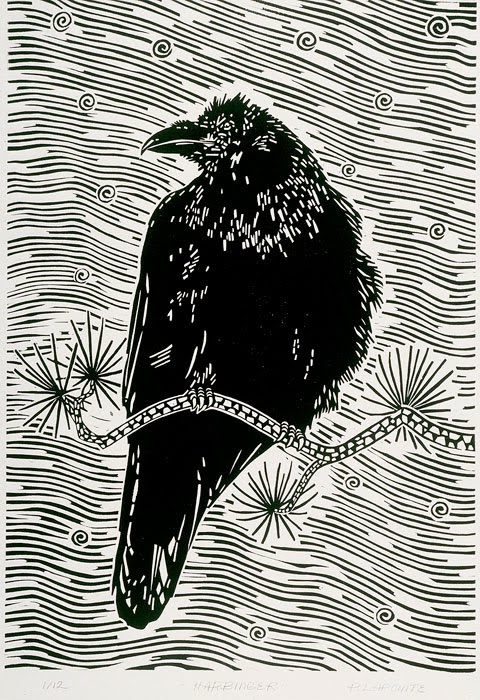
Harbinger by Paul Lapointe, Woodcut on paper

Dry point etching, in contrast, is known as an “Intaglio” printmaking technique. This process can be considered the opposite of relief printmaking; the ‘carved’ areas are the parts which will pick up ink, as if one was to naturally draw with a pencil. Drypoint etching is accomplished through scratching or “etching” into a metal plate (traditionally copper) with a sharp pointed instrument. Then, the plate is inked up. Instead of printing the plate as is, however, like you would with the woodblock, the ink is pushed into the etching, usually by dragging a piece of cardstock in all directions on the plate. Then a piece of tarleton cloth is used to clean and pick up the extra ink sitting on top of the plate. The ink should be in the plate, not on the plate, for this technique. Then the plate is run through the printing press with slightly damp paper (which will pick up the ink better than dry paper).  
 a diagram depicting how paper lifts the ink out of the depressions in Intaglio printmaking (Wiki commons)


Mackenzie Bee by Paul Lapointe, drypoint on paper with chine-collé

While woodcut prints have a graphic, sharp edged feel, drypoint etchings tend to have a soft look to them. This is primarily due to the “burr”: a rough ridge of metal thrown up on each side of the line created by the etching tool. The result is a soft and dark image with great potential for detail and intricacy. The different strengths in these techniques are portrayed well by Lapointe’s work, which is often themed around nature and its forces, animals, and landscapes.  Having grown up in Northern Saskatchewan, Lapointe’s earliest influences were that of the natural world (SCC Membership Directory).Two great examples of these techniques are Lapointe’s pieces Dancing Raven and Muskeg Spruce, both pieces on view now at the SCC Boutique!

For great resources on printmaking techniques and ideas, check out the following resources:


SCC Fine Craft Boutique: Cindy Obuck and Felting


Submitted by: Maia Stark, Gallery Assistant

Let’s talk about our feelings. Well, actually, I’d like to talk about feltings and fullings—the pun was well worth it, wasn’t it? Felting is a process that occurs when fibers are physically agitated, so that they seem to knit themselves together. Microscopic scales cover filaments of animal hair (wool, for example), and these scales swell open when agitated, causing filaments to interlock with each other. This agitation can occur through physical agitation, moistness, or changes in the pH of the fibers from using soap.[i] Felt is known to be one of the oldest fabrics known to humankind, as anthropologists have found artifacts of felted materials dating back to 500BC! The characteristics of felt being strong but light, and water and wind-resistant at certain thicknesses made it the perfect choice for tents and clothing for nomadic groups.[ii] 

Neck warmer with button, detail, Cindy Obuck, (SCC Boutique).
There are many ways to felt wool, but there are two main distinctions: wet felting and dry felting. Dry felting requires the use of a felting needle, which has barbs cut into its metal shaft allowing the needle to snag and intertwine filaments.[iii] Wet felting uses heat, moisture, and agitation to turn the loose wool fibers into felt. For example, some artists compress the wool with soapy water, then roll the wool sheet in bubble wrap or thermal wrap, and use a combination of rolling, throwing, and kneading over hours to create a good quality dense felt: a very laborious process![iv]  It’s important to note that “felting” is quite different from “fulling.” Felting uses raw wool, while fulling is a process applied to wool that has already been treated in a particular way; fulling is the process of fluffing up an already woven or knitted piece of woven cloth, while felting does not use any sort of weaving process for initial structure.[v]

Cindy Obuck, a professional craftsperson with the Saskatchewan Craft Council, was always interested in art but never investigated it outside her qualifications as a graphic designer until discovering felting. Self-taught, Obuck mostly uses welt felting and needle felting, and even quilting techniques to create her unique wall hangings and wool sculptures.[vi]

“Anemone Delight,” Cindy Obuck, 2013 (cindyobuck.com).


“Prince,” mONsTer pODs, Cindy Obuck (cindyobuck.com).

Obuck has a sensitive approach to her work, creating subtle variations in tone and hue. The range of her work is impressive as well, from comical monsters to beautiful neck-warmers with buttons, and sturdy purses with leather straps. Despite the various incarnations, each piece Obuck makes incorporates her signature whimsical style.


Neck warmer with button, Cindy Obuck (SCC Boutique).

If you are interested in purchasing one of Cindy Obuck’s pieces, or seeing what other fabulous work we have in store, please visit the SCC Fine Craft Boutique, located in the Saskatchewan Craft Council’s Affinity Gallery at 813 Broadway Avenue, Saskatoon, SK.

[i] strongfelt.com
[ii] Amanostudios.com
[iii] strongfelt.com
[iv] Amanostudios.com
[v] Fuzzygalore.biz
[vi] Cindyobuck.com

SCC Fine Craft Boutique - Oval Shaker Boxes

Submitted by: Sydney Luther, Gallery Assistant

Our brand new SCC Fine Craft Boutique is filled with beautiful pieces of many different mediums, a few of which our readers may not know much about. We hope to educate these readers through a new collection of blog posts highlighting the different mediums and styles of work we feature in our boutique.

The History and Creation of the Oval Shaker Box
 
Wayne Dueck is a woodworker from Saskatoon who is a juried member of the Saskatchewan Craft Council. He specializes in the oval Shaker box, which is a sturdy wood box with a tight fitting lid, the style of which was invented by an American religious group known as the Shakers. 

Wayne Dueck's oval Shaker boxes come in many different sizes.
The Shakers, more formally known as The United Society of Believers in Christ’s Second Appearing, is a group which began in the 17th century in France, but soon after immigrated to the United States. The group focused on creating a utopian society based on the virtues of purity, pacifism, tolerance, and equality of the sexes. In the early 19th century, the Shakers reached their peak membership, with more than 6000 Shakers living in 19 different communities in the eastern United States. Today, the last remaining Shaker community is located in Maine, after their numbers dwindled throughout the 19th and 20th centuries. 

Dueck's boxes are created without any glue, only copper tacks.
The Shakers strived for perfection in everything they did, and this can be seen in their fine but simple woodworking. Dueck agrees with the society’s focus on the utility of handmade objects, and not only beauty. This worldview is engrained in Wayne’s creation of the simple Shaker boxes, which are fashioned using no glue, but only small copper tacks. His design is taken directly from the original Shaker tradition, which dates back to the 1790s. Dueck uses quartersawn cherry and birdseye maple wood in his Shaker boxes, which feature uniform, slender sides, symmetrical joints, and tight fitting lids. Coated with a combination of beeswax and linseed oil, the boxes come in a variety of sizes and can be used to store an assortment of household items and personal treasures. The boxes range in price from $40-$80, depending on their size.

Dueck's Shaker boxes are featured in the SCC Fine Craft Boutique.

If you are interested in purchasing one of Wayne's traditional oval Shaker boxes, please visit the SCC Fine Craft Boutique, located in the Saskatchewan Craft Council’s Affinity Gallery at 813 Broadway Avenue, Saskatoon, SK.


BOUTIQUE - Now Open!

Submitted by: Sydney Luther, Gallery Assistant

Welcome to the SCC Fine Craft Boutique!
The staff at the Saskatchewan Craft Council is extremely excited about the opening of our brand new SCC Fine Craft Boutique located in Affinity Gallery! The Boutique features pieces from over fifty Juried members of the SCC who have created a wide range of giftware and smaller handmade pieces. These include jewellery, wall pieces, small sculptures and carvings, hats, scarves, dishes, trinket boxes, magnets, and even some hand sewn postcards! Our aim is to mainly feature pieces in the price range of $20 to $120, but we have some small pieces as priced as low as $5 and a few select larger pieces worth upwards of $800. Our hope is to make Fine Craft accessible to people on any budget.