Manifesto for Making: Report


Submitted by: Vivian Orr, SCC Marketing and Communications Coordinator

Manifesto for Making: Report
23 March 2013
The Manifesto for Making was held as a part of the Heritage Crafts Associations’ annual Spring Conference at the Victoria and Albert Museum, London on 23 March 2013. The report is worthy of interest from us on the other side of the pond.
The first line of the forward to the report:
 If there is a key message I take from this manifesto it is that craft is central to life not a sideline, making is a crucial part of what makes us human.
 ~Robin Wood, Chair of the HCA
Conference delegates were asked three questions. Here is a brief summary of their responses.
1.       Why is making important? The responses indicated that making is important not only to the maker, but to everyone as human beings. There was a lot of emphasis on the importance of making on an emotional and personal level, with particular reference to fulfilment and satisfaction, and to the opportunity to express creativity.
2.       Where should making be? The responses indicated that making needs to be much more visible and prominent and should be physically everywhere. There was a particular emphasis on craft in education at all levels, as a way of giving people access to making.
3.       How do we get there? The dominant responses reflected non-makers. They indicated that publicity and promotions are vital to get making to where it should be – in the public consciousness. Another set of responses were maker specific and focused on the need for practical support for makers: marketing assistance, training, business and financial support.


A Sociological Point of View

Submitted by: Sydney Luther, Gallery Assistant

As a Sociology student and non-artist working at the Saskatchewan Craft Council, I think I have a unique view of the artist and their work. I admire the courage it takes to choose to be an artist for a living and I have developed an understanding of the value of the unique work produced by our membership.

Photo source
Anyone who has taken an “Introduction to Sociology” course knows about Karl Marx’s theory of alienation. If you haven’t, or you need a refresher, here is a summary: Marx theorized that Capitalism creates alienation between the worker and the products he or she is hired to produce. 

In Capitalism, the lowest working class citizens are employed as factory workers and in other production-line type positions. For example, imagine a job in which one’s only responsibility is to place toothpaste caps on toothpaste tubes as they roll down a conveyor belt, day in and day out. These types of positions do not allow the worker to have a voice in what they are producing and have no impact on what later happens to these products. 

Consider the Line Cook: he has no say in what kind of food is prepared, he just knows which ingredients to put together to create the exact same dish every time. The Head Chef designs the dishes, and the Line Cook simply follows instructions. Obviously this Line Cook is not going to stay very excited about food, when he’s creating the exact same dishes every single day for weeks or months on end. Marx labeled this lack of passion for the products the worker is creating as alienation from the product. This leads to alienation from the act of producing – which is basically a lack of passion for one’s job. If a person has no part in designing the product they create, and no influence on what happens after they do their part, of course they are not going to gain any happiness from their job!

As I was sitting in class learning about Marx, my professor asked us how one can avoid such alienation from one’s job and the product one creates. This sparked an obvious answer within me: become an artist! The artist is someone who rejects the basic ideas of capitalism. An artist designs whatever he or she wishes to create, and then follows through with the creation process. An artist never creates the same piece twice and, as I've seen from the members of the Craft Council, can choose to create a vast array of different types of products in different mediums. The artist then has the power to choose what happens to his or her products. He or she sets the price and decides to who they will sell. This type of power in the process of production avoids the capitalistic alienation of which Marx warned.
I write all of this just to say that although the life of an artist may not be a wealthy one, and it may not be the easiest road to choose, I truly believe it can lead to happiness. If you were meant to create, then you should be creating in any way you know how!
For more information about Marx’s theory of alienation, check out the Wikipedia page on the subject here 

The book in which Marx presents his theory of alienation
photo source


Relief and Intaglio Printmaking: Spotlight on Paul Lapointe

Submitted by: Maia Stark, Gallery Assistant

Printmaking is chosen as a form not only for its ability to create multiples, as discussed in my last blog post, but also for the unique qualities that various printmaking techniques offer. Paul Lapointe, a professional craftsperson with the Saskatchewan Craft council, employs many printmaking techniques in his repertoire as a multi-media artist. In particular, Lapointe works with woodblock printing and drypoint etching.


A selection of carving tools, available from Lee Valley Tools

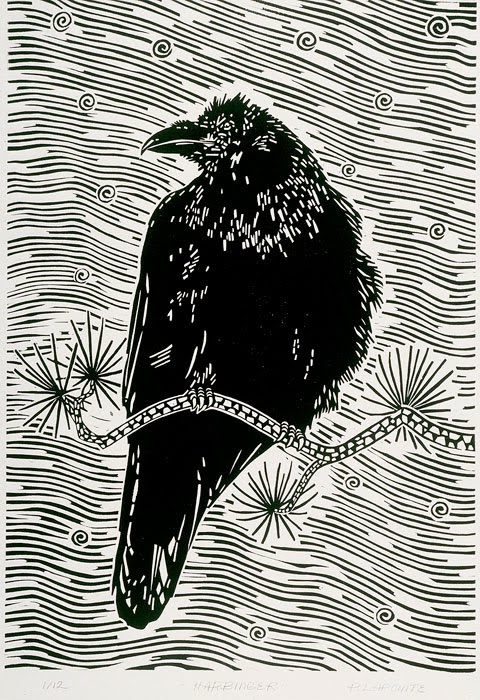
Woodblock printing is known as “relief” printmaking. In this process one would, using carving tools such as the ones pictured above, carve out sections on the woodblock according to a pre-planned design. These areas which are carved will not pick up ink, and so the “relief”—or highest point on the block—is what will be printed. When running a roller of ink over top of the board, the carved out areas will remain white. This process can be thought of as the opposite of drawing with a marker- what you touch will not be printed, what is left behind will pick up ink. Woodblock prints can be monochromatic, or, “one-colour:” this means that the printmaker would have only printed one layer of ink (e.g, a black and white woodcut, where the “white” is the paper). Woodblock prints can also be multi-colour however; so that after printing a first layer, the printmaker would go back to the woodcut, carve more wood away, and print another colour over top of that first layer. This is called “reductive” printmaking, and works from lightest to darkest- the very last un-carved areas left on the block will be printed in the darkest ink as the layers of colour build up.
Relief printing: A represents the block, B is the paper lifting the ink away from the block. (Wiki commons)

Harbinger by Paul Lapointe, Woodcut on paper

Dry point etching, in contrast, is known as an “Intaglio” printmaking technique. This process can be considered the opposite of relief printmaking; the ‘carved’ areas are the parts which will pick up ink, as if one was to naturally draw with a pencil. Drypoint etching is accomplished through scratching or “etching” into a metal plate (traditionally copper) with a sharp pointed instrument. Then, the plate is inked up. Instead of printing the plate as is, however, like you would with the woodblock, the ink is pushed into the etching, usually by dragging a piece of cardstock in all directions on the plate. Then a piece of tarleton cloth is used to clean and pick up the extra ink sitting on top of the plate. The ink should be in the plate, not on the plate, for this technique. Then the plate is run through the printing press with slightly damp paper (which will pick up the ink better than dry paper).  
 a diagram depicting how paper lifts the ink out of the depressions in Intaglio printmaking (Wiki commons)


Mackenzie Bee by Paul Lapointe, drypoint on paper with chine-collĂ©

While woodcut prints have a graphic, sharp edged feel, drypoint etchings tend to have a soft look to them. This is primarily due to the “burr”: a rough ridge of metal thrown up on each side of the line created by the etching tool. The result is a soft and dark image with great potential for detail and intricacy. The different strengths in these techniques are portrayed well by Lapointe’s work, which is often themed around nature and its forces, animals, and landscapes.  Having grown up in Northern Saskatchewan, Lapointe’s earliest influences were that of the natural world (SCC Membership Directory).Two great examples of these techniques are Lapointe’s pieces Dancing Raven and Muskeg Spruce, both pieces on view now at the SCC Boutique!

For great resources on printmaking techniques and ideas, check out the following resources:


The Craft Factor - The Many Faces of Michael Hosaluk

Volume 18, Number 1 Summer 1993

The current show on display at the Affinity Gallery is "Put a Wedge in It" - an exhibition of new work by artist, craftsperson, designer and maker Michael Hosaluk and invited friends. Using the wedge as their theme for discovery, the group of collaborators have created a range of fascinating and diverse works.


Hosaluk: Expedition (Wedge Heads)
Photo: Vivian Orr
Michael is a longtime member of the SCC and his exhibitions have graced the gallery over the years. In 1993, his show "Faces/Places" was in the gallery, and today we will take a look at the article "The Many Faces of Michael Hosaluk" written by Alicia Popoff about that show.


The article discusses Michael's style and analyzes a number of the pieces.


Read the fulll article here

"Put a Wedge in It" can be viewed in the Affinity Gallery until February 22, 2014.  Learn more about the show here

The History of Ugly Face Jugs

Submitted by: Sydney Luther, Gallery Assistant

Bonnie Gilmour, a longtime member of the SCC has been recently focusing on a new line of work: face jugs. These jugs have a fascinating history, which adds to the charm of these works of art. There are many differing stories concerning the history of these ceramic jugs, known throughout history as ugly jugs, voodoo jugs, devil jugs, or simply face jugs.


The first account of the history of these jugs is that they were created by African peoples who were slaves in the United States in the 1800s. These jugs were found around North Carolina and Northern Georgia, dating back to the 1840s, throughout the Underground Railroad, and in gravesites in known slave areas. It is said that the daunting faces were meant to scare away the devil and other evil spirits, so that the souls of the departed could go to heaven. These slaves obviously had a strong spiritual connection to these jugs, considering how often they appear in their history. Slaves were often not allowed to have tombstones, and so some theories suggest that these jugs functioned as grave markers because of this.

Another account of the jugs is also from slaves in the United States, but these people were brought to the U.S. from the Caribbean, where belief in voodoo was very popular. According to this story, the jugs were involved in some sort of voodoo ceremony, and the style of ceramic vessel was brought to the U.S. by these artists.

Another common historical account of these jugs is from the prohibition of alcohol in the United States during the 1920s. Moonshine was stored in ceramic jugs at this time and the frightening faces were created to scare children from drinking the liquid inside the jugs. Other sources state that artists made the jugs so ugly because they supported the prohibition and wished to dissuade anyone from drinking the alcohol inside.

Bonnie Gilmour creates her face jugs with a sense of humor and names each separate jug, which is fitting since each is unique and has a strong individual character! To see more of Bonnie’s face jugs, please visit her website here

For more information about the face jugs, please visit the following links:

"Business Beginnings" with the Women Entrepreneurs of Saskatchewan Inc.


Submitted by: Vivian Orr, SCC Communications & Publications Coordinator

I attended “Business Beginnings”, a FREE one-hour session that introduced me to Women Entrepreneurs of Saskatchewan (WES) and their services. WES is a non-profit membership organization which works with women who are considering starting a business, purchasing a business, or operating an existing business.
Programs and services offered by Women Entrepreneurs of Saskatchewan (WES) include business advisory and support services, start-up and expansion lending, networking and mentoring opportunities, and business development seminars which focus on entrepreneurial skill development.

 I left “Business Beginnings” with quite a few interesting resources which I want to share:
·        24 page Start-Up Guide that includes:
o   Step-by-step guide to starting a business
o   Entrepreneurial self-assessment
o   10 Essentials of a business plan
o   7 Point checklist for your business plan
o   Forms of business organizations
o   and – the part that I really want to mention – three pages of contact information ranging from federal, provincial and municipal government contacts to Canada-Saskatchewan Business Service Centre, BizPal (licenses and permits), BizLaunch (free webinars for small business) to Western Economic Diversification Canada.
·        WES hosts a Lunch Hour Series which includes topics such as:
o   Selling & Buying Business
o   Is Your Website Mobile Ready? and
o   Image Matters! You can attend in either Regina or Saskatoon.
·        WES also has interesting webinars both live and previously recorded ones:
o   In the Green (How to ‘Green’ Your Business)
o   Keep Calm & Lead On and
o   To Incorporate or Not to Incorporate?
·        WES has educational seminars:
o   Business Planning Seminar, useful for those who are at the very beginning stages. Lending institutions want to see a business plan as part of their lending process.
o   Financial Series
o   Marketing Series
o   Human Resources Series
·     WES highly recommends the On-line Business Plan Development Seminar for those who cannot attend their seminars in person. It consists of 4 modules and is presented by the WECM Entrepreneurship Centre of Excellence.
·     Another on-line seminar they mentioned is 100 Essential Small Business Skills presented by the GoForth Institute
·      One more tidbit: Information Services Corporation (ISC) and the Government of Saskatchewan have partnered together to provide a website to complete the business registration process in Saskatchewan on-line.
WES staff were helpful, friendly and informative. If you are looking for education, support, advice, mentorship or a clear-eyed assessment of your business, consider contacting Women Entrepreneurs of Saskatchewan Inc.


“A Night with Saskatchewan” Fine Craft Showcase in LA

Submitted by: Sherry Luther, SCC Executive Director

“A Night with Saskatchewan” was held in Los Angeles on December 12 2013.  The Saskatchewan Craft Council had been presented with the opportunity to showcase  Saskatchewan Fine Craft at the residence of the Canadian Consulate General in Los Angeles (Hollywood). This initiative was spearheaded by SaskMusic; also attending were Sask Publishers, SaskArt (formerly SPAGA), SMPIA (SK Motion Picture Industry Assoc) and SIMA (SK Interactive Media Assoc) .


The SCC jumped at the opportunity to do join in on this project. It was thought that this would be a good opportunity to represent SK Fine Craft as a whole and to possibly make connections with US galleries to tour Dimensions and art dealers for representation.

With very short notice the SCC put together a small exhibition of 9 pieces of exceptional, unique and distinctive Fine Craft to take to LA for this one day event. By using images of work shown in the Affinity Gallery and content on the SCC Membership Directory, the SCC staff had invited 20 juried members to submit work to be considered; from the replies received the following works had been selected, packed and shipped off to Los Angeles.


Lee Brady, glass, "Moonlight Perch"

Michael Hosaluk, wood, "Bowl of Strange Fruit"
June Jacobs, fiber, "Gems of the Salt Flats"
Daryl Richardson, metal, "Dimpled Copper Bowl"
James Korpan, metal," Windswept"
Rod and Denyse Simair, clay "Ondas Christalina Floridas"
Dale Lowe, wood, "Maple Burl Vase"
Paula Cooley, clay, "Smoked Quartetto
Megan Hazel, white gold and silver jewellery,  "Surrounding Necklace"

The SCC designed business cards of the participants with a full colour image of their piece and contact information, links to their websites and the SCC Membership Directory. A bundle of these business cards were included in the gift bags along with the SCC Playing Cards and brochure. Also included was a copy of the catalogue for Dimensions, our touring exhibition.  


The display pedestals and lights were sourced and rented in LA. The pedestals available were a departure from the plain wooden white ones that the SCC normally uses in that they were white plexi-glass with internal lights. 


These came in handy as even with the rented additional lighting the room remained dimly lit so the additional light from the pedestals helped to display the work. Bevin Bradley, SaskArt representative, and I worked together to set up the exhibition in the dining room and the end result was impressive.


As the guests arrived the natural flow of the home brought them into the exhibition space first after receiving their programs. I had several conversations with guests who enjoyed the work, had many questions and genuinely wanted to learn more about the Fine Craft artists we were representing. Comments were overheard about how they were surprised and delighted (enlightened?) that work of this caliber had come from Saskatchewan.


I had supplied 17 names of individuals who either owned or worked for galleries/museums that had an interest in Fine Craft to invite to this event. I gathered these names by polling all the provincial Craft Councils and the American Craft Council. During the evening I met Ray Leier, an art dealer, who was aware of and admired Michael Hosaluk’s work. He was also aware of the EMMA International Artists Collaboration that the SCC helps to organize. I spoke with Suzanne Isken, Executive Director of the Craft and Folk Art Museum, at the event and met with her at her office the next day. I had set up the appointment with her to specifically talk about the possibility of showing the SCC “Dimensions” exhibition in her space. She is a source of valuable information and I think she will be a useful contact for us.

The event as a whole went very well and ran smoothly. I appreciate the help, hard work and leadership from SaskMusic and look forward to future opportunities to showcase Saskatchewan Fine Craft. This initiative would not have been possible without the financial support from Creative Saskatchewan.