Maud Lewis and East Coast Folk Art

Submitted by: Maia Stark, Gallery Assistant

This lucky Gallery Assistant had the great pleasure to spend some time on the East Coast this June, and while being visually overwhelmed by cliffs and waves and whales, she managed to spend some time at the Art Gallery of Nova Scotia and, on a friend’s recommendation, went to check out the AGNS’s permanent collection of Maud Lewis’s work.

Despite knowing a bit about folk art (or so I thought) I hadn’t heard of Maud Lewis before this moment—to my own surprise, as she is apparently one of Canada’s most beloved and well-known folk artists. Her life story, struggles, and seemingly never ending positive outlook on life make her story a compelling one.
Maud Dowley was born in 1903 in South Ohio, Nova Scotia. As a child who developed juvenile rheumatoid arthritis as well as being born with some physical disabilities, Maud often played by herself and stayed close to home. To assist her family in her own way, she began painting and selling Christmas cards. Maud’s parents died while she was still quite young, only in her late twenties, and it was her brother who inherited the family home. She stayed with her brother and his wife for some time, but then moved to Digby to live with her aunt—here was where she met Everett Lewis, a fish peddler who further encouraged her painting and the two were married in 1938 (AGNS). Having little money and little access to proper painting materials, Maud used any and all materials available to her. She painted with hobby paint and house paint on board, cardboard, dustpans, even baking trays. I could imagine that, if she was a contemporary artist now, these pieces may be considered sculptural in form.
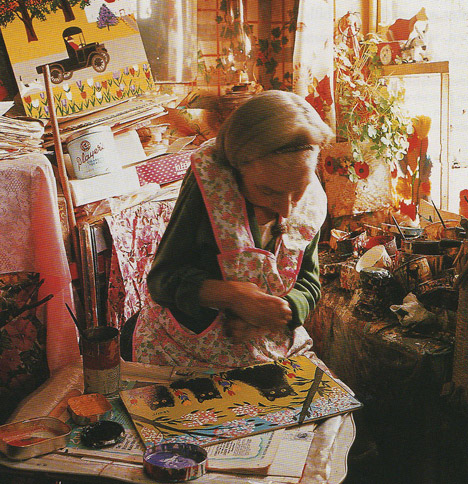
Maud Lewis in her small home in Marshaltown, Nova Scotia (Source)
Everett and Maud’s house was small—only 16 square metres in area, consisting of one room with a sleeping loft upstairs (AGNS).They had no electricity, and no plumbing their entire lives. A poor couple, Everett supported them selling fish while Maud sold her paintings and cards. Maud’s rheumatism worsened as she got older, and so spent most of her time painting at the window, advertising her pieces through a roadside sign. Maud’s work, though locally known, sold for very little most of her life.  The most she ever received for a painting was $10. Despite Maud’s secluded life, she clearly understood visual composition and colour theory, as the AGNS points out:
"Although she was not a formally trained artist, Maud's work demonstrates that she had a strong sense of composition, learned from close observation of any visual material that came her way--postcards, calendars, greeting cards…Her early paintings are quite complex in arrangement as she tackles harbour scenes, rolling farmland and countryside.”
Oxen by Maud Lewis (source)
Recognition and fitting payment for her work came much too late—after a CBC TV broadcast and multiple newspaper stories about the folk artist in 1965, Maud fell and broke her hip; her health declined and although she was getting requests  for paintings from people all over the world, it was difficult for her to acquiesce (Artist Biography Database). Maud passed away in 1970, having lived most of her life in poverty and with difficult health problems. As is the case with so many valuable artists unrecognized during their lifetime, Maud’s work now sells for upwards of hundreds of thousands of dollars: money she and her husband were never able to use to help bring them self out of poverty. Despite her struggles, she seemed to have a joyful outlook and transcended the circumstances of her life with a rich archive of “bright and evocative paintings” (Triad film productions).

The AGNS not only has a large collection of Lewis’s work, but they’ve also reconstructed and preserved her small home from Marshaltown, Nova Scotia, which had been adorned with years of painted decoration. Maud had, during their marriage, painted most of their home with decorations of birds, flowers and insects.

The house as it appears in the Art Gallery of Nova Scotia (source)


Caption: The interior of the Lewis home (source)
After Maud’s death in 1970, and the death of Everett in 1979, the painted house began to deteriorate. A group of concerned citizens from the area started the Maud Lewis Painted House Society, their goal being to save the valued landmark. In 1984 the house was sold to the province of Nova Scotia and put in the care of the Art Gallery of Nova Scotia (AGNS). A testament to the importance of community and the local artist, the little house reconstructed in the gallery space is a wonderful sight.  Maud’s work reflects a make-do aesthetic, one which is culturally relevant to settler generations of Nova Scotia.
  

Social Media 101: Part 2 - Twitter & Instagram

Submitted by: Sydney Luther, Communications Assistant

Read Part 1 here.

Similar to Facebook, Twitter is a social media website. Tweets are like Facebook status’, but are limited to 140 characters. You can share photos with your tweets, and you can also tweet links to other websites. 

An example of a tweeted picture.

An example of a tweeted link.

On Twitter, people can follow your business’ account and then they will see your tweets in their twitter feed. You can use Twitter on your computer or as an app on your phone or tablet. There is no distinction between individual accounts and businesses or organizational accounts. Twitter is also useful for you to keep up with what’s going on with artists you like, businesses with which you are affiliated, organizations of which you are a member, news outlets that you read, the city in which you live, and 

even celebrities in whom you are interested. If you follow people, they are likely to follow you back.
On top of creating your own tweets, with photos or links, if you so choose, you can also retweet others' tweets. This means you are sharing their tweet with your followers. This is useful when you are hoping to share information about an event or about another artists' work. 

Tweeting quick, informational tidbits is helpful for readers to keep updated on your business. Feel free to tweet links to give more information. Twitter will shorten links as to help you with your character count. You can tweet more than is recommended to Facebook or Instagram, since the posts are shorter and more compact. Tweeting several times in a row is fine, if you have more than 140 characters of information to share. Posting on Facebook or Instagram several times in a row is less acceptable.  

Instagram is a photo sharing app that you can only use on a personal mobile device, such as a smart phone or tablet. You need to download the app to be able to use it. For some reason, you cannot post via the website, but you can sign into your account and view other’s posts on the website. Since you create art, Instagram is an awesome way to share your work! Always caption your photos, and feel free to share with your Facebook page. Avoid overusing filters, however, since you want to show the public what your art looks like in real life. Overusing filters can also appear unprofessional. 


An Instagram photo shared to Twitter.
When sharing to Twitter, your tweet will simply share a link to your Instagram profile, which is not ideal. I would recommend tweeting the same photo as a Twitter photo, instead of sharing via the Instagram app. This way, the photo will open in a viewer’s Twitter feed.  

Hashtags are great for Instagram, Facebook and Twitter! A hashtag is a label you can add to any message that will let people view it who don't follow you or like your page. Hashtags don’t work from private or personal Facebook pages, but they do work when you use them from a public page. Both your Instagram and Twitter accounts are public (and they should be!) and using a hashtag lets people searching for related subjects stumble upon your work.

For example, if I am visiting Edmonton and I would like to see what’s going on in the city, I may search the hashtag #yeg (This is the airport code for Edmonton and it has become common practice to use these codes as a hashtag). I can see the most popular or the most recent posts by anyone who used that hashtag. If someone had just tweeted about being at an art market in Edmonton using this hashtag, I may view this and decide to go to said market! The same goes for both Facebook and Instagram. Hashtags may seem trendy or annoying, but they are helpful when it comes to reaching out to the public. Again, try not to overdo it, however. There is a fine line between professional and annoying. 


The most popular tweets on a hashtag on Twitter.
The most recent tweets using a hashtag on Twitter.


The bottom line about social media is this: try it out. See if it's for you. Don't write it off as something that simply won't work for you or your business. Perhaps start by looking at other businesses' profiles and judge for yourself. 


For more information about Twitter and Instagram, check out these links:


Twitter for Business

Why Artists Should Use Twitter
Instagram for Business
Instagram for Artists

Social Media 101: Part 1 - Facebook

Submitted by: Sydney Luther, Communications Assistant

Social media may seem like a fad or something only teenagers are interested in, but these websites have become an important and useful tool for any non-profit organization or business person. Social media are defined as any media that exist on the internet "that allow for the creation and exchange of user-generated content. Furthermore, social media depend on mobile and web-based technologies to create highly interactive platforms through which individuals and communities share, co-create, discuss, and modify user-generated content." Social media are used to relay information between individual people, organizations, and businesses. Facebook, Twitter, Instagram, YouTube, Vine, Pinterest, and Google+ are all examples of social media. 

At the Saskatchewan Craft Council, we utilize three of these social media: Facebook, Twitter and Instagram. Currently, we share almost all posts between these three websites, but there is a move towards creating different types of posts for each of these individual sites, as it creates a reason for someone to follow all three accounts. However, it is up to you how you would like to best utilize social media. 

Facebook is useful for a business or non-profit in that almost everyone is on it. This is no longer just a young person’s tool. My 92-year-old grandma uses Facebook! Facebook can be used to post photos, status updates, videos, events, and links to other websites. You can also share your Tweets and Instagram photos with your Facebook account. 

An Instagram photo shared to a Facebook page


As an individual business person, if you are hoping to use social media to raise awareness about your art, you should create a page for Facebook, and not an individual personal account. This means people can like your page instead of friending you individually, and they will still see your updates in their news feed. 

It's difficult, but important, to find a balance with how much you post on Facebook. Too much, and you run the risk of being annoying. Too little, and people may not know or care that your page exists. A business’ Facebook page is about sharing a product, sharing where to get said product, and sharing how the product is made. Feel free to share personal photos of you in the studio, but avoid those photos of you and your friends at the bar or of your grandchildren at the lake. Save such posts for your personal Facebook. Although social media feels casual, you should still conduct yourself in a business-like manner. 

There are many lists of tips on how to conduct oneself on Facebook. Most say you should be yourself, but also be professional. Post things that you would be interested in as a reader. Stay positive about everything you post. Promote yourself confidently and respond to people's questions and comments quickly and succinctly. Use proper grammar and punctuation and don't try too hard to be "cool" or "trendy." Facebook is definitely something used by people of all ages, so don't fall into the trap of attempting to speak or write like a teenager. Social media is all about sharing information and creating an online community.

For more tips about using Facebook, check out these webpages: 


Seeing Beyond the Object

Submitted by: Carmen Milenkovic, SCC Executive Director

I’ve only started here. July 2nd was my first day.
What I’ve come to know, seated at my desk on the second floor, is that I fashion any possible reason to wander down the staircase to the gallery below. Opening the door to that magical space immediately changes my mood, relaxes my sometimes frenetic mind and draws a gasp.

The exhibit on now – Art of the Book – is simply beautiful. If you haven’t made it to the Gallery you have until Saturday the 12th of July at 5PM to wander through its profound display of book binding and creation.


Susan Carr, Mexico, 2012. Photo by Mike Sullen
I take in one or two of the pieces with each descent down the staircase. I wonder at the inspiration and marvel at the execution. I’m not a creator but I’m a passionate book lover. And it’s not only the content that makes me a fan. I love the feel of the book, the softness of the front cover, the way the pages flip open, and the paper on which the printed word is lovingly held. I run my finger down the spine, and read the notes – the raves, the bios, the synopses – and I assess its possible place on one of my shelves (or more likely the piles that I’ve come to accumulate). I must say that I have to hold my hands behind my back as I wander through this exhibit – everything about the art pieces cries out to be touched, and yet I know I shouldn’t.

Patricia Owen, Collected Proverbs of Erasmus, 2013. Photo by Mike Sullen
On Monday, I was in the gallery at the same time as Martha Cole, a major Saskatchewan artist, one of our patrons, and a member of the Canadian Bookbinders and Book Artists Guild – the organization that curated and is touring Art of the Book 2013. She was with a friend, a fellow artist, visiting the exhibit. Les Potter introduced us; following a brief exchange, we stopped to look at Collected Proverbs of Erasmus by Patricia Owen. Martha told us that this was a masterpiece as it was carved from wood and wrapped with a fine skin of goat leather that was then painted. I've looked at that piece many times, but it wasn’t until Martha told me about its intricacies did I realize how truly wonderful it was. I hadn’t picked up the catalogue, available to all gallery visitors, to read about the process. And so, even though my eyes recognized something special, I didn’t understand why - until I spoke with Martha.
Thanks Martha. I’ll pick up the catalogue from now on.


Locally sourced materials: Clay

Submitted by: Maia Stark, Gallery Assistant
I was lucky enough, this summer, to participate in a university class offered by the U of S which taught soil science and art students alike to grind their own pigments and make paint from natural and local sources. It was an incredible experience for many of us, who had only ever bought paints from a store and had no clue what chemicals and minerals made “ochre yellow” different from “burnt sienna”. We made black pigment out of burnt bone, yellows and reds from soil samples, and greens and blues from types of rocks (such as malachite and azurite). It was a fascinating course, and I couldn't help but wonder about the potential for craftspersons to find their own local clay for pottery and sculpture—as some of the soils we used to make pigment were certainly fine enough to be used for pottery and ceramic work. While I myself am not a ceramic artist or sculptor, one of the other MFA students collected clay while we were up north, and has herself previously sourced local clay for her work. For this post, then, while it is still fresh in my mind, I’d like to share some of the research I've done on using natural sources for artist materials, in particular, clay!

First off, a quick note that digging for clay and soils should be done in such a way that the environment is minimally disturbed. The University of Minnesota Natural Resources Research Institute website has some helpful tips for digging your own “pedon,” or soil pit.

“. . .it is best to use a shovel with a flat, square spade so the sides of the pit can be smooth and relatively undisturbed. Dig a pit at least 1/3 of a meter (~ 1 foot) on each side and at least 35 centimeters (~1 foot) or more deep. Don’t be too destructive; only dig a pit large enough so that you can see the layers of soil relatively easily. Take care so that at least one side of the pit is straight down and smooth, so that the natural layering of the soil visible and not disturbed by the digging. When you are finished, be sure to put the soil back into the pit, or mark it so people will see it and not fall into it!”
-NRRI
Secondly, you want to be sure that you have permission to dig. Even on construction sites, where the earth may already be helpfully torn up, you need to have permission to enter the site. As well, it’s important to know that it is illegal to remove anything organic from national parks!


Clay from Exeter, New Hampshire (Kit Cornell Pottery)
 An excavation in Exeter reveals a cache of local clay (Kit Cornell Pottery)
When you are digging for your clay, you will probably end up with a collection of clay and less fine types of soil mixed in. However, this doesn't mean you have to painstakingly pick out all the good clay when you first take your sample of soil.

Eddie Starnater of the website “Practical Primitive” has a method of extracting good quality clay from samples which are full of less fine soil and sand by using water to separate the materials. Clay is lighter than sand and so by settling the mixtures (letting heavier soils fall to the bottom), one can quite easily obtain a good quantity of pure clay. This process, though not physically laborious, does have to take place over several days (Starnater’s process can be found here).

There are other ways of separating your clay from extraneous matter, and Kit Cornell of Kit Cornell Pottery has a method which is outline on her website, here.
Cornell is an artist from New Hampshire who uses clay that she finds locally. On her website, Cornell notes that naturally sourced clay, as opposed to commercially bought clay, can have wonderful surprises in colouring, as the influence of mineral and chemical deposits will vary the clay’s raw colour from reds and browns to even greens.
For Cornell, using local sources of clay for pottery and local oxides and ash for glazing is an important part of producing handmade products. This has been a very attractive concept to me, as well, after taking the course which taught me to harvest my own pigments. Being able to supply my own materials enhances the concept of the local and handmade (while also being accommodating financially)! For instructions and information about Cornell’s process, check out her page on clay here.


Artist Spotlight: Donna Cutler

Submitted by: Sydney Luther, Gallery Assistant.

Donna Cutler
Donna Cutler is a fine craft artist featured in the SCC Fine Craft Boutique. The artist, who resides just outside of Saskatoon in Beaver Creek, focuses mostly in the medium of free motion embroidery. Although she was originally self-taught, she went on to receive a certificate for Art and Design Level III at the Gail Harker Center for Creative Arts in Washington State, as well as certificates in hand embroidery and machine embroidery. Cutler says, “I arrived at fiber art through a long process of trying many other art forms. I started out drawing as a child, then as an adult, developed an interest in sewing, rug hooking... I also worked with various forms of hand needlework. Later on, I took a quilting class which was pivotal for me, as it led to art quilting.”

Cutler, who grew up in Winnipeg, specializes in what she calls ‘thread paintings,’ in which she depicts nature in near-photographic detail. She remarks, “I'm very lucky now to live south of the city within easy access to places like the Beaver Creek Conservation Area and Cranberry Flats.” Cutler takes many photographs of everyday nature settings to recreate using thread and embroidery techniques. She also utilizes photographs her husband Adrian takes, as well as ones supplied to her by good friend Judy Wood.

Autumn Birches by Donna Cutler
Cutler’s work is unique from other fibre artists’ because of her extreme attention to detail, which creates incredibly realistic looking textures. This style is not one that is easily replicated. She also dyes all her own fabrics and spends most of her summers dying fabrics at her home.
Bend in the Creek by Donna Cutler
On top of her unique fine craft work, Cutler also teaches and does commissions. To read more about this, check out her blog here. Cutler will be a Feature Artist at Anna Hergert’s Open Studio Workshop June 27th and 28th, 2014 and will be selling her work at at Art at Solar Gardens (previously Art at Agar's) in September. Cutler’s beautiful work is also for sale in the SCC Fine Craft Boutique. Please come visit and check it out!

Oceanic Experience Wellness Artist Program

Submitted by: Kimberly Murgu, SCC Festival and Curatorial Assistant

What is Oceanic Experience Wellness?
http://www.oceanicexperiencewellness.com


OEW is a sensory deprivation float tank facility that is located at 828 10th St. E. Saskatoon, SK. They opened their doors in the fall of 2012, and have been providing a space for deep creativity, healing and reflection ever since. They do this by providing you with sustained periods of weightlessness. Giving your mind, as well as your joints, muscles, and bones a rest.
Essentially, you enter a tank, and your body rests on a solution of water and 800 lbs of Epsom salts. The water is heated to 93.5*F, which is the same temperature as your skin. This causes your perception of the water begin to dissolve over a period of time. You are free from all the distractions of the outside world, as no sound, light or touch sensations can reach you.
What are the Benefits of floating?
http://www.oceanicexperiencewellness.com


When you no longer have to struggle against gravity, your body can easily enter a state of healing and rest. Many people find significant relief from chronic pain. With this greater potential to heal, your joints decompress, your spine lengthens, and blood flow is increased. Sufferers of chronic conditions such as fibromyalgia have been known to have experienced dramatic relief from just one visit in the float tank.
We weren't designed for the fast paced environment we are exposed to every day. We are all in need of quick and easy ways to calm down our nervous systems, and the float tank provides this.
When you free your body from gravity and outside stressors, you can discover deeper levels of your own creativity and intelligence. Artists have found this to be a perfect place for inspiration.
What is the Visual Artists Program?
Float-inspired art by Shinichi Moriyama

The program is open to artists of all kinds, and provides you the opportunity to exchange your creativity, time and skill for the unique experience of the float tank.
If you are serious about your work, Oceanic Wellness will provide you with two free floats in exchange for a piece of artwork inspired by your experiences in the tank.
The first float will be 90 minutes in length, and you will have 24 hours to start your artwork. Your second float must be within two weeks of your first, and you can stay in the tank for as long as you wish. You then have 30 days to have your finished piece in to Oceanic Wellness.
How to apply
 Float-inspired art by Jared Morgan

Go onto the Oceanic website. Download the contract, and send some examples of your work with your application.
If selected, you are entered into the database, and every month, 10 artists are chosen from this list.
How to prepare for a float
Float-inspired art by Tia Davis
Don’t drink coffee for several hours beforehand
Don’t shave or wax, as the salt water can irritate your skin
Eat a light meal about an hour to 90 minutes ahead of time.
If needed, bring a hair brush, and your contact lens container.
Everything else is provided.

For more information, check out the OEW website, Facebook page, give them a call or even just stop by.
828 10th St. East, Saskatoon, Sk.
1 306 361 6446
Open 24 hrs a day